Advieh – a Wonderful Persian Spice Mix

After running around Kings Park, along the Swan River and up Jacob’s Ladder this morning I went to Subiaco Markets. To my delight, the Spice Library stall had advieh, a traditional Persian spice mix. I didn’t know it was called advieh until today but I certainly recognised the smell.

During my 2004 Iran holiday I bought a plastic jar of advieh from Shiraz Bazaar. After returning to Mersin I used this yummy spice mix in most meals for 3 years including pasta, roast vegetables, stir fries and curries.

The following photo I took at Shiraz Bazaar shows a man taking some advieh out of one of the two advieh mixes. I love how the different spices are layered. In the central top section of the photo are plastic jars containing advieh.

Following is my empty jar prior to throwing it out in June 2007:


Iran’s Election Dramas And Protests

Over the past 10 days I have been keeping a keen eye and ear on the Iranian election farce and associated events. I had the pleasure of visiting Iran in 2004 (see a, b, c, d, e, f and g) and lived next door for several years so am very interested in the country’s current affairs.


82900016


In a peaceful and beautiful Isfahan, 2004


Iran is an amazing country with unlimited potential. The wonderful Iranian people deserve to be heard and not controlled by violent thugs and unelected gurus if they don’t want to be.


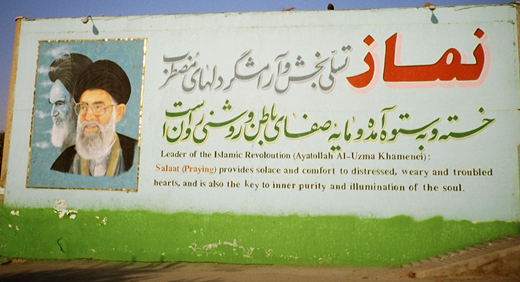
 82900013_Iran_Sign_for_blog


Another photo from Isfahan, 2004. So much for “…provid(ing) solace and comfort to distressed, weary and troubled hearts…”


My main sources of news have been the http://nomadlife.org website (thank you Dody), #iranelection tweets and the BBC World Service on News Radio. Kylie, a friend from Adelaide moved to Tehran 4 weeks ago to join the AIESEC Iran Member Committee. What a time to live abroad for the first time! Her fascinating firsthand stories of the events in Iran are here and here. I kind of wish I was there now.


After a week of mass protests followed by a lull yesterday, there is a feeling that today will be a turning point in the saga and perhaps even in Persia’s distinguished history. Fingers crossed all will work out for the better…

Tehran 3 (at last)

Finally, the next update from my Iran trip, the trip that now seems a piece of ancient history.

Sunday 5 September 2004

For breakfast we ate fresh mangoes and ugly, flat peaches (the kind we had previously eaten in Tabriz. The 2 mangoes were the first mangoes I had eaten since the 1st half of 2003 in Australia. They were not the best mangoes but they were far better than the zero mangoes I had eaten in Turkey!

Tehran University was our next destination and a taxi-ride later we were there. Across the road from the university were many bookshops, a few of which we entered and looked around. Although the summer holidays had not finished, there were still many students in the vicinity.

Karin and I tried to enter the university but we were not allowed in without a permit so the security guard asked the closest student to take us around the corner where we could obtain our permits. This kind student, who spoke no English, went with us until we eventually found the correct office located across from the main campus. He was rewarded with some cezerye I carried in my bag specifically to give to a kind person. At the office Karin gave her ID for the university official to photocopy and the woman asked us if we were journalists. A ‘no’ was a good enough answer to satisfy her and we received a piece of paper with Farsi writing – the permit. Officials in another office were satisfied with this permit and were free to enter the university.

At Tehran University’s side entrance we gave the paper to the security guard and then proceeded on to the campus. Architecturally, the campus was not striking. However, it was not the architecture that drew me there. Tehran University was the seen of many of Iran’s political and social struggles. With very few people on campus I could only imagine the riots and protests that have taken place in the past. We walked past the large covered square. Every Friday thousand of men pray their midday prayers on the rolled-out carpet. This prayer gathering would be a sight not to miss on my next visit to Tehran.

We relaxed on a bench and read a few of the local English language newspapers purchased earlier in the day. Another brief walk and our Tehran University experience was almost complete. I write almost, because we exited via the main entrance. Painted on the ground at the main entrance were Israeli and US flags with most of the colour gone from years of Iranian soles treading on them. I recall seeing footage of the flags on Australian TV several years ago. As the security guard was at the and gate and the flags were faded, we did not bother taking photos.

For the taxi to Imam Khomeini Square the driver wanted 20,000 rials but I gave 15,000 as it was really a 10,000 rial trip. The taxi vehicle was a modern car – our only taxi ride in a new car for the whole trip – all the rest were . On the way we passed a church, also modern-looking.

Our intention at Imam Khomeini Square was to visit the National Museum. We walked around and around but could not see a sign for the museum anywhere. We were about to enter a park the vicinity of the museum but were still unsure when a man wanted to have a chat. He claimed he had obtained an Australian visa in Damascus. The man also pointed us in another direction to the museum. Around we walked again.

On the way, I chatted to a diplomat’s chauffeur. Several almost identical Mercedes Benz sedans and the odd equally luxurious 4 wheel drive, each with flags indicating different countries were parked. Italy, Slovenia and Finland were amongst the countries represnted but, unsurprisingly, I didn’t see any US or Israeli flags. The chauffeur’s car had the flag of Cyprus, including the whole island, although only the bottom 2/3 is controlled by that country. Of course he spoke English and he explained the way to the museum. Near the museum is the Ministry of Foreign Affairs. The Ministry is located in a beautiful building but it is not a place to take photos.

The second time at the small park we ignored the weirdo who had provided the previous, incorrect advice and made our way to the National Museum. I really believe the museum should be signposted better.

The museum cost 6,000 rials. Previously, foreigners paid 60,000. The museum was small when compared with the Museum of Anatolian Civilisations in Ankara and particularly, the massive Egyptian Museum in Cairo. However, every piece on exhibit was of great quality. Lots of items on display were from the historic sights of Persepolis and Susa. I recommend people see the museum after Persepolis to improve the museum experience.

The National Museum ticket gave free entry to the Islamic Museum. The decorative arts in this museum were very interesting but Karin and I were too tired and hungry to look over all the exhibits set on levels 1 and 2 seriously.

We managed to hold our hunger until we reached ‘Tomato’ restaurant, located close to the British Embassy. I chose ‘Bacon and Mushroom’ pizza. Iranian substitute bacon does not quite taste the same as real bacon! For Iran, the price was pricey: 2 medium pizzas, 1 pineapple drink, 1 coke, 1 cappucino and 1 delicious French coffee came to 72,000 rials (about USD 8.50).

The music in the background was either German or 70’s/80’s metal music. A curtain could be moved in front of the window to protect couples from the pry of the street. One man and woman did utilise this when we were there. The customers were young and liberal.

We walked back around the British Embassy to the Pars Internet Cafe. The patronage consisted of locals, Nigerians and other foreigners. Nigerians were also staying at the hostel. I don’t know what they were doing in Tehran but from their vibe and the way they looked and spoke to Karin I don’t think they were here for positive reasons. Having said that, I bet they also suffered from racism here. We didn’t see Nigerians anywhere else in Iran. The computers had malware on them and it was not a good Internet cafe.

On the way to the hostel I changed another USD 100 (for 87,000 rials), our 3rd $100 changed in 3 days – fast compared to the rest of the trip. Back at the hostel we packed our bags and paid 100,000 for 2 night. We didn’t actually stay 2 nights but we arrived 7 am the first day and left 8 pm the next. We presented the workers with some Turkish delight and one of them, the one who sleeps at reception, went with us outside to hail a tax that would take us to Azadi bus station, western Tehran, for 20,000 rial, the normal rate. We were to catch a bus back to Tabriz.

The taxi ride(s) to Azadi was a classic experience. Traffic was at its horrible best – slow, but the cars, motor bikes and other vehicles still jostled for position and tried to gain every single millimetre they could. I mentioned the “(s)” after “ride” because the first taxi ran out of “benzine”. The way the driver tried to restart the car several times made me think he had ran out of diesel.

We had waited long enough and the bus departure time of 9.30 pm was fast approaching so I stepped out, gave the drive 15,000 and hailed another taxi (actually, any car that stopped – both taxis didn’t have “taxi” written on them). We made the terminal on time and walked to the bus company’s desk to be directed to the correct bus. Azadi bus station is a large and chaotic station even by Turkish standards. I enjoyed the chaotic (the word just fits perfectly so I have to use it twice) journey to the terminal even though we didn’t know where we were when the first taxi conked out and there was a chance we could have missed the bus. The journey personified the essence of Tehran.

Monday 6 September 2004

After midnight the bus stopped for longer than 30 minutes for a toilet and prayer stop. I guess we had to wait until the last person finished praying, no matter what the scheduled departure time was. I slept very well on the bus the Tabriz despite the lack of leg room and seat reclination (we were in the back row). Conversely, Karin did not sleep much at all.

Tabriz

At about 6 am Karin woke me up as the bus had stopped outside the Tabriz bus terminal. We got off and then Karin remembered the bag of posters left on the overhead shelf above our seats. She ran off after the bus at the speed of light to successfully retrieve the bag.

The local taxi driver insisted on 20,000 for the trip into the city. This was the same journey only in reverse that a taxi driver had previously asked for only 5,000. On a park bench near the bazaar we sat, wondering which hotel to go to. We wanted a more comfortable place than the previous Tabriz hotel. We ended up at the Park Hotel, a hotel that looked good in its day, assuming one was referring to the 1970’s or 1980’s.

For 80,000 rial our large room contained ensuite shower and toilet, fridge, TV and the only double bed (or pair of single beds together) we saw in Iran. There were even inbuilt lamps for each side of the bed and a heart-shaped mirror! The toilet was broken, there was no hot water, the TV reception cable was broken, half the lights didn’t work, we didn’t bother plugging in the fridge, the drinking glass stuck to the plate and the hotel was under renovation but we didn’t care as the bed and pillows were comfortable.

‘Tabriz: the 2nd time’ will be my next Iran update

Tehran Continued

Across the road from the old American Embassy are a number of souvenir shops. We entered several of them, looking for a present for Devrim and Efkan for the occasion of their wedding that we both missed. We decided on a copper vase coated in white porcelain with a traditional blue pattern. This handicraft is famous in Isfahan.

We took a modern taxi (most taxis are old) ride back to Khomeini Square. On the way we passed a church. At a pharmacy we couldn’t find an Iranian brand of condoms for Karin’s boyfriend in Istanbul. Surprisingly, condoms are openly on display in Iranian pharmacies. We felt embarrassed leaving the pharmacy after only gawking at the condoms, all of which were international brands.

At a nearby juice shop we drank fresh mango, pineapple and banana juice. Next to us was an Indian who lived and worked in Tehran. Unlike most foreigners in Iran, it was not so easy to pick him out. On another occasion in Tehran we saw a Sikh man and woman – they were easy to spot!

To get to Cafe Naderi, next to the hotel of the same name, we walked past the British Embassy again. According to the Lonely Planet, the local intellectuals come to this cafe. Althought the seats and tables did remind us of a school cafeteria, the cafe did exert a certain element of coolness. I enjoyed the Turkish coffee, cake and just sitting, relaxing in such a ‘wow’ city and location. Karin did not find her filter coffee to her liking although the addition of a substantial amount of milk made the flavour quite palatable in my opinion. The cafe has a restaurant next door although we did not venture there to try their meals. In the male toilet, outside, at the back and right side of the cafe, I used something I never witnessed anywhere else in Iran – a pisser. For those not in the know, a pisser is the individual porcelain bowl anchored to the wall for males to urinate into. I was 10 or 11 when I first remember seeing one of these in the local Catholic church toilets. I don’t know why pissers are not common in Iran.

The cafe was closing and we left to walk back to the hostel. On the way we walked past a transvestite! I did not get a good look at him/her/it but Karin saw the lipstick, make-up, the whole lot. Doesn’t quite fit the stereotypes of Iran, does it?

This is what I love about large cities – there is a large variety of people and styles. ‘Different’ people can fit in, in such cities.

We stopped at a newspaper stand to look at some local publications. As well as the daily English-language newspapers, we bought some Farsi newspapers and several Farsi magazines. The most interesting magazine was a women’s sewing magazine. All the models wore hats or similar covering their heads. For evening dresses and other clothes that would normally expose their shoulders, arms and lower legs, the models wore a skin-tight layer of tops and bottoms that covered these parts. Visible on one of the dresses the model’s left nipple indentation. Iranian porn!

Another interesting fact, in my opinion, is all the women featured were ‘old’ compared to equivalent western magazines. I guess mid-30’s. The cultural inference with having an older woman is, I believe, she is married and she is not ‘selling herself’ like could be seen with a younger model as used in western magazines. What I just mentioned could also be rubbish and the women models were mid-30’s because this was the same age as the target group of the magazine. Like in western magazines, the women were thin. This sewing magazine was rather expensive for Iran, at 25,000 rials (USD$3).

Back at the hostel I used the Internet before going to bed. Microsoft Word on the hostel computer was very frustrating as it was the Farsi version. Of course I could write in Latin script, but the line breaks were on the left of the page and the script kept reverting back to Farsi.

Some general points I had written down in my diary at this stage of my trip

-All the lemons were uniformly small (like a giant olive) and most were light green in colour.

-Ice is still delivered to many businesses. Large, long and square in circumference pieces of ice were common on the city streets in Iran, especially in the morning.

-Several (most?) TV’s still retained their stickers on the screens like when they were new. Even the in train stations. It must be of some imortance or status to keep the sticker there as it impedes the view of the top of the screen.

-As expected, Tehran is more sophisticated than the rest of the country. A greater variety of people and shops and a more liberal dress were displayed. Unfortunately, I didn’t get to visit Northern Tehran where the rich and liberal elite live. I would have liked to spend a few hours in the cafes and parks there on a summer evening.

-Many aspects of the India<->Turkey influence are visible from the food, spices, fruit, people, culture, etcetera. I find fascinating the variations and shared influences between the countries across this part of the world.

-Almost all police cars are new shape, white Mercedes-Benz sedans. I find this an outrageous expenditure for a poor country. I’m sure the government received a good deal from MB but I can’t imagine how many jobs could be created with the money in lieu of these cars. One local said the cars were bought because they would be faster than the criminals.

-In the heat of the early afternoon many shops and people take a ‘siesta’ and close for 3, 4 or 5 hours before opening again in the late afternoon. Eminently sensible, particularly in desert places like Yazd.

-Small water channels were located on the roadsides in all the cities visited. I’m not sure of the exact purpose(s) of such channels. If somebody said they were sewers I would believe based solely on the smell although I did not see any physical evidence of sewerage.

-The largest note in Iranian money is the 20,000 rial, also known as 2,000 tomans and 2 Khomeinis. Its value is about USD$2.30. This note was only introduced in the past year or so and is uncommon. In fact, we only saw the note once in the whole trip when a money-changer was going to give us a few 20,000’s. Instead, we accepted 10,000’s. Given the low value, large bundles of 10,000’s are common.

-Even though we were both from Australia (During the last half of the trip Karin said she was from Australia as it fitted with our ‘marriage’) not one person mentioned anything about Australia’s involvement in ‘TWAT’ (the war against terror). People, men in particular, were far more likely to mention the final qualifying game for the 1998 soccer world cup between Australia and Iran. The winner of the 2 match home and away series would win entry to the world cup. The first game in Tehran was a 1-1 draw – a satisfactory result for a Australia as the team may not have survived if they had won in Tehran 😉

At the Melbourne Cricket Ground in the second game, Iran came from 0-2 down to draw 2-2 and win the series on the away-goals rule. I laughed and shared the joke when Iranians mentioned this game. As an aside, Australia was the only undefeated side in the 1998 world cup yet they did not qualify for the finals.

-No smoking areas are common, including cafes and other businesses. I hardly recall seeing one such area in Turkey.

-The tap water is drinkable everywhere. Public water stations are provided on virtually every street. I’m sure many of them are provided by people and businesses out of their generosity.

Stay tuned for Tehran 3

Tehran

Tehran is one of the world’s great cities and a metropolis of 12 million people. A peculiar motivation for coming here was to experience some of the world’s craziest traffic (thanks Uran for the tip). More about that later…

For some time we waited inside the Tehran train station. 5 am was too early to go and look for a hotel room. Besides, train stations are a great place to observe society, particularly in a country like Iran where the train stations we saw (only Yazd and Tehran) were new and not sleazy.

Upon leaving the train station we were directed to the official taxi booth. For Mashhad Hotel the fare was 25 rials, expensive when compared to other cities in Iran but this is Tehran. The taxi driver ended up taking us to the Hotel Mashhad, the wrong place. He then insisted on an extra 10 rials to drive us to Amir Kabir Avenue, the vicinity of the Mashhad Hotel. He didn’t know where the Mashhad Hotel was and ended up pointing us in the wrong direction for Amir Kabir after saying he could not drive further because it was a one-way street. When he asked for extra payment I should have asked for and written down his details. He then probably would have lifted his game!

In the early morning I could already notice Tehran’s pollution. Tehran also has bus-only lanes. These lanes are most likely to promote public transport and combat the pollution and traffic of private vehicles.

The Mashhad Guesthouse (also called Mashhad Hotel) cost 50,000 rials per night for a double room. Karin and I dropped our bags in the room and went for a walk to Khomeini Square. At a café we drank pre-packaged juices and bought alcohol-free Efes Pilsen beers imported from Turkey. I haven’t seen the alcohol-free version in Turkey and imagine it is possibly an export only product. We also purchased a copy of each of the 3 English daily newspapers: Tehran Times, Iran Daily and Iran News.

We walked in a random direction and ended up in the embassy district. On one side of the street were the German and Turkish Embassies. On the other side, with concrete barriers surrounding it, was the British Embassy. The UK and Iranian governments have not experienced the best relationship over the past year. The embassy was attacked a few times and the heavy security presence is a reflection of this. One of the embassy buildings visible from the outside displayed windows with holes from bullets and or explosives.

Back at Khomeini Square we caught the metro west to Azadi. A woman was kind enough to help us with any questions we had. The first 2 or 3 carriages on every metro train are reserved for women although I once saw a man in one of these carriages. Karin stayed with me in the men’s though, like some other women. One ticket on the metro is 650 rials. Tehran’s system is modern and the carriages were built in China.

A short, shared taxi ride (1,000 Rials) and we were at the Azadi Tower. This is possibly the most prominent landmark in Tehran. The Azadi Tower was built in 1971 to celebrate 2,500 years of Persian civilisation. The tower is 45 metres tall and provides welcome shade from the summer sun. It is situated on a roundabout, moonlighting as a park with lawn and trees. A policeman/man in uniform took great delight to blowing his whistle to get people off the lawn. A family was moved twice after they tried to picnic under the shade of two different trees. In the distance to the west several air force jets took off, one after another. Before and after these flights, commercial passenger jets took to the sky. Tehran’s main airport is west of Azadi.

After some confusion and with the help of a boy (who received some Turkish delight for his efforts) we found the Azadi bus terminal. Buses to the north and west depart from Azadi, a large terminal, even by Turkish standards. We were looking for a bus to the Caspian Sea for a day trip between Tehran and Tabriz. Karin particularly wanted to visit this part of Iran. As there were no convenient buses for our schedule, we bought tickets direct to Tabriz. Karin was tempted to go direct to Istanbul to meet her special ‘Turkish delight’.

One very interesting thing I observed at Azadi bus terminal was a young girl, aged 7 or 8 I guess, wearing a headscarf AND a shoulder less dress. The irony!

The bus terminal (I always write ‘terminal’ because it is called this in Farsi, only with a French accent) also contained the first supermarket we had seen in Iran. Although it wasn’t a big supermarket, it was a supermarket nevertheless.

A ride in an unmarked taxi to a metro station (not Azadi, but one stop east) and a metro journey later, we were back at Khomeini Square. Near the square I bought fresh mangos! After a lunch of tuna, jambon (not made from pork) and salad sandwiches sleep was calling.

In the afternoon a second taxi brought (the first one demanded too much money) us to the sight of the old American Embassy. This was one of my reasons to visit Tehran. The outside wall of the form embassy block is decorated with anti-American propaganda. Of course I don’t support the propaganda but I had heard of its notoriety and I didn’t want to miss it. We continued snapping away taking photos until Karin spotted a soldier looking at us unpleasantly from above. The cameras were put back in their bags and we decided we had seen enough of the embassy, happy to have not had our film/digital media taken. I will include a picture or two of the propaganda when I post some photos of the trip.

I will add the next Tehran update soon

Yazd to Tehran

Back at the Silk Road Guesthouse Karin and I packed our gear and I paid the account. The accommodation and meals for the 2 days came close to 200,000 rials. All but 40,000 was for the lovely Indian and Iranian meals and accompanying rose and mint waters.

A taxi ride later and we were at the train station. For a city so old, Yazd is surprisingly spread out and distances are relatively large.

At the train station entrances we were both waived through our respective luggage checks. As promised, the gorgeous lady and the man at Information had come up with the tickets to Tehran (35,950 rials each for 2nd class).

The train was a long, all-sleeper train completely full of Iranians. In the 2nd class compartments 3 beds fold out from each side, making 6 beds in total. Prior to dinner in the dining car, there were 5 young Iranian men in our compartment.

For dinner we were recommended the chicken. We ended up with the mixed chicken/lamb shish covered in rice with half a lemon, an onion wedge and a butter portion on the side. Vegetables? If I remember correctly, the diner cost more than the train ticket!

A man and his son asked if they could sit next to us. The man was kind of weird so we were happy when they left.

When we returned to the compartment an old, friendly couple had replaced the 5 men. The compartment was hot. Do train compartment come in anything but hot or cold?

We folded out our beds on the top row. Despite the heat, the sleep that night was very good. At some stage the ticket inspector woke me up to check the tickets. Of course, as the man, I have the tickets and I am the one woken up!

04 September 2004

Just before 5am the old man also woke me up as the train was travelling through the suburbs of Tehran.

I was very happy to take at least 1 train journey in Iran. Next time I’d like to take more, particularly during the day.

Yazd

This morning Karin and I arrived in Tabriz around 6am from Tehran. When we got off the bus we forgot a bag on the overhead space. Karin remembered and then chased the leaving bus to fetch the bag. Tomorrow we are back to Turkey. In the meantime, here are my belated notes from Yazd:

Yazd

We arrived at the Silk Road Guesthouse at around 10 pm. The Silk Road is located in the centre of the old town, near the Good Friday Mosque (Mesjid Jameh). The setting is great and the guesthouse courtyard is relaxing place to while away the very hot (45 degree C) afternoons. The restaurant includes a number of Iranian and Indian meals. I looking forward to sampling both cuisines, particularly the Indian, as there is no good Indian food available within a plane flight of Mersin. The vegetables on the first night were very good!

For 10,000 Rial one can sleep on the roof. The view from the roof is great and mosques, water towers and many old buildings are visible.

02 September 2004

Waking up in the hot sun, listening to some awful violin playing by an Iranian guest, I had a drippy nose.

In the morning we walked around the old city. The buildings are largely mud-covered brick. The old city streets are narrow, many too narrow for cars. Motorbikes rule in Yazd. Unfortunately they bring noise and exhaust fumes to the old city.

Did I mention motorbikes rule in Yazd? Waves and waves of the 125cc bikes roar around the old and new sections.

On one obscure corner there was a woman beggar. We gave her 2,000 rials and she was very happy. Similar to the 2,000 rials I gave to an old man in Shiraz for taking a few packets of chewing gum he was selling. The look on his face was priceless.

Many of the old buildings have cooling towers built on top of their roofs. The towers have channels for the wind to go down and cool the interior of the building.

I was absolutely delighted when I saw a juice place in Yazd with fresh mangoes. Although the mango juice contained added sugar (as is the standard for fresh juices in Iran) it still was bliss. My first fresh mango product in almost 18 months!

Mangoes are not grown in Iran and have to be imported. I don’t recall seeing a mango in Turkey. If I did see any mangoes there, they were in poor quality and not worth the exhorbitant price.

That day a couple of hippies left the guesthouse for Afghanistan. I wonder how there trip will turn out…

In the afternoon we entered the Water Museum (10,000 rials – a private museum). This museum explored and detailed the way water was gained in old times through “qanats”, underground channels. As Yazd is located in the desert, water was and still is very important.

My nose continually ran during the day and provided an unwelcome distraction.

Unlike the bazaars in Tabriz, Esfahan and Shiraz, Yazd’s bazaar was not very large or good.

For the afternoon and evening we were with Thomas, a Finnish person of Swedish ethnicity studying in Switzerland. We caught a taxi to the Zoroastrian flame. A flame sacred to Zoroastrians that has kept burning for over 1,000 years and in 3 or 4 different locations.

Another taxi and it was off to the Towers of Silence on the outskirts of Yazd, about 7km from the centre. Here, up until 40 years ago the Zoroastrians used to leave the bodies of their dead on 3 bowl-like constructions at the top of hills. The bodies would then be picked at by birds until all that was left were bones. The sunset and the mountains and city in the distance were very pretty.

A bus and a taxi ride later we were at the train station. The train station has different entrances for men and women with the women entering a curtained area to the right and the men an uncurtained section to the immediate left.

Thomas wanted to catch a train that night to Kerman and we wanted to go the following night to Tehran. Unfortunately, the gorgeous woman at the information booth said both trains were full. A short while later a man came and after some discussion they said we were able to obtain tickets. Thomas’ 2am train ticket to Kerman actually started two towns prior to Yazd! He deciphered this from the ticket with his knowledge of Arabic script. Karin and I were told to return to the train station and pick up our tickets at 7.30pm the the next night prior to the 8.15pm train to Tehran. The station staff had gone way out of their way to help us!

Alighting from our taxi back at the guesthouse we heard some ‘noise’ coming from the Friday Mosque. It sounded different to the usual call to prayer. After some hesitation we entered the half indoor/outdoor mosque. As it is thedesert rain is rarely a problem.

The Imam was chanting, mentioning the name “Reza” (one of Shiite Islam’s 12 sacred Imams) many times. The men were largely sitting at the frontal sides while the women were at the back. We were handed glasses of tea with the customary irregular-shaped ‘cubes’ of sugar on a plate at the side. Like in eastern Turkey, the sugar is meant to be dipped in the tea and then placed in the side of the mouth. As the tea is drunk, the sugar dissolves.

At least one of the men was very emotional and others showed signs. We were not sure of the purpose of the prayers. Thomas and I (not Karin as she is female) handed back the empty tea cups and trays and after several minutes we exited the mosque for the guesthouse.

That evening I ate camel meat balls in gravy with rice. After several discussions and debates between the 3 of us, Thomas left to catch his 2am train and we went to bed.

That night was colder than the previous one and my nose ran liberally.

03 September 2004

Waking up in the morning I had a full-blown cold and I felt miserable. After the 5 ‘sh’: SH**, SHower, SHave, hand waSHing clothes and bruSHing my teeth I was slightly better.

The heat of the day was spent at the guesthouse chatting with Brigitte and Stefan, 2 Austrians currently cycling around the world. They started 26 April from Spitz/Danube, Austria and if all goes well they will cover 46 countries in the next couple of years. Their website is at www.heath-net.com/bikeabenteuer.

Later in the afternoon I spoke to Mum and Dad in Australia. Karin and I then drank another fresh mango juice (this time with less sugar) and bought some local Yazd sweets, one of whom was called ‘baklava’.

Early tomorrow morning we are leaving for Turkey and I will be back in Mersin on Wednesday morning. From there I will write my next post: travelling to Tehran.

Shiraz to Yazd to Tehran

I have so much to write about – my notebook contains 10 pages of reminder notes for me to expand upon. I am writing from the Mashad Hostel (not Mashad Hotel!) a shortwalk from the Emam Khomeini Square in Tehran.

Shiraz

One morning in Shiraz a reasonably old man with awful teeth approached us offering his services as a guide for no charge. As we were in Iran we went with him. In Turkey or Egypt we would have ignored or walked away from him but in less touristy Iran even the touts are genuine.

The guide showed us around the bazaar and explained the history of the buildings, religious and non-religious. We entered a Madresse. Fig, orange and persimmon trees as well as date palms and rose bushes grew in the central courtyard of the building. Tiles with Nightingales and flowers decorated some of the buildings. Think of the Garden of Eden.

At the bazaar the guide suggested we buy all sorts of stuff we neither wanted nor needed so he could obtain a commission. He also had a very funny looking hand-written business card on a piece of scrap cardboard. After we had enough of him we parted ways with both him and his requested payment of 20,000 rials.

Later at the bazaar we bought some saffron and an unusual mixture of many spices colourfly displayed in a large bowl. The spices will be great with fish, white and red meats and vegetables.

Across the road from the bazaar we bought lemons. I (as the male) asked for ‘half’ a kilo. When seller requested more than 10,000 rials for payment we thought this was very strange. After witnessing him shovelling the lemons into a second bag we understood the confusion. ‘Haft’ in Farsi means ‘7’. Half and haft have similar pronunciations. By the way, ‘hafta’ in Turkish means ‘week’ (7 days).

Persepolis

On our 2nd and final morning in Shiraz we took a Pars Tourism Agency tour to Persepolis, the ancient city ruined by Alexander the Great all those years ago. Although I would have preferred to go by myself, the tour was only USD 7 (or equivalent rials) per person and the convenience could not be beaten.

The only other tourist on the tour was Dean. His surname is the same as a famous Australian cricketer of the 1980’s. Dean is travelling onwards to Pakistan so good luck to him. Given the cricket fanaticism in Pakistan He wants to disclose his surname to as few people as possible there.

On the 50 km journey to Persepolis I witnessed a very funny sign. A business on the side of the road displayed “Rottonest Service”. I do not have a clue what it means but the connotations for the business are not very good.

Speaking of signs, the guide asked us what the acronym “C.B.D.” meant as this was written on some signs on the way to Shiraz. I was the only person who knew the meaning: Central Business District. Even the Englishman didn’t know. I guess the Iranian who designed the signs had studied in Australia, not knowing CBD is a localised expression.

Before the actual sight of Persepolis we visited a another historical sight with a few Necropolises (graves cut into rock) and a funny square temple.

The actual sight of Persepolis is on a massive scale, covering 12 hectares if I recall correctly. The ancient reliefs were very impressive. There is also a small museum on the grounds. I am certain the Internet contains a wealth of information concerning this world heritage sight so I won’t write in detail.

The guide helpfully dropped Karin and I off at the bus terminal where we waited for our 2pm 2nd class bus to Yazd.

The Ride to Yazd

There were no convenient ‘Volvo’ class buses to Yazd that left in the early afternoon so we took a 2nd class bus. Although the ride is slower and less comfortable, we thought it would be good to mix with another group of Iranians. We wanted an early afternoon bus so we could see the countryside.

The wind shield at the top front of the bus was written “BUTYPRINCESS”. We assumed this meant “BEAUTY PRINCESS” and not “BUT Y PRINCESS?”, “BUTTY PRINCESS” or “BUT PRINCESS”. At a similar position near the rear window was written “NATASHA”. In Turkey, ‘Natasha’ is a reference to a prostitute from the former Soviet Union countries.

The interior of the bus was very tackily decorated. Almost all the cliched tacky additions were there except for hanging dice and fox tails. We had seats 1 and 2 so the view through the front of the bus was good. There was nothing between us and the front window (tacky decorations aside). People paranoid about safety would not enjoy such a ride.

The scenery on the journey ranged from green valleys to jagged mountains and desert plains. In one area there were several white marble factories. I do not recall seeing one petrol station along the way. I guess fuel distribution is government-controlled as there are very few petrol stations and the price is very cheap. I have heard it is 1/8 of USD$1 per litre of petrol and 1/44 of USD$1 for diesel. This contrasts sharply with Turkey where there are fuel stations everywhere and petrol is more then USD$1!

At one point we passed a scrap metal truck on its side with some of its load on the road.

We passed through Abakouh, a town with many beautiful ancient walls and a few funny cone-shaped buildings looking wonderful in the evening light. Here the kind woman sitting across from us left the bus before we could access our bags to give her some cezerye and Turkish delight. Earlier this woman had paid some money for a koran for Karin that a boy had given on the bus. The woman also gave me a pair of ‘Lee’ socks and Karin a set of hosiery socks out of the kindness of her heart. Possibly the only occasion Karin will wear the hosiery socks is at a fancy dress party.

Just past Abakouh we stopped for a toilet break. This stop was much longer than planned as the bus had a flat tyre which required repairing. I took the opportunity to walk down a village street. At the end of the street I took a photo of some sunflower flowers with ancient buildings and mountains in the background. I hope it turns out. I then jumped on the back of a motorbike driven by a bespectacled boy no older than 14.

Back at the main road the boy took a photo of me with my camera and then clicked a few times in quick succession. The photos will be wasted but who cares when one has priceless experiences like this.

Another boy then grabbed me and I took a photo of him, two men and a third boy. At least two of the four were wearing ‘shalvar’, the baggy pants often worn in Turkish villages although from observation, less often worn in Iran. The 2nd boy also insisted on a photo with him pretending to use a mobile phone. Mobile phones are becoming more common in Iran but they still have nowhere near the penetration of Turkey or western countries.

As darkness arrived the bus eventually left. The remainder of the 8 hour journey was not very fun as the assistant kept on bumping me as he walked passed whilst I was trying to sleep. The distance between my seat and the middle front seat was very little but at least he could have been more careful. The customer service level on Turkish buses is far superior to Iranian buses.

As the hotel worker wants to sleep (it is almost 11:30 pm) I will sign off for now. I still have a huge amount to write on Yazd and Tehran. I will hopefully both continue my blog writing and reply to comments and emails tomorrow.